
For the past two decades, the smartphone has been the king of digital transformation. We have condensed our workflows, our communications and our operational data into the mobile phone. But, as we move through 2026, a new technology is emerging that may become the preferred choice for enterprise businesses. Currently, in some physical environments, AR glasses are gaining popularity as the chosen solution.
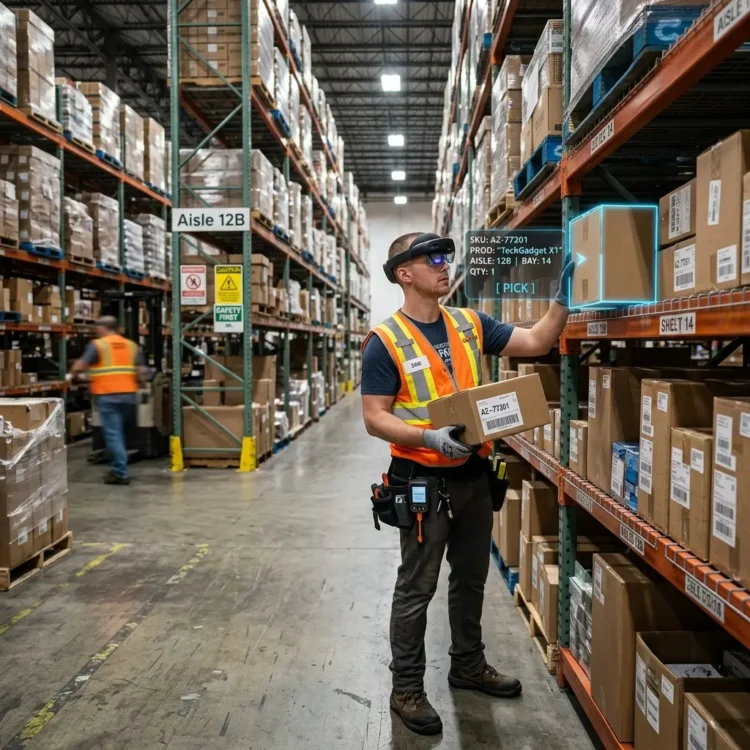
Think about a warehouse worker, an aviation engineer or a local mechanic. For these professionals, holding a tablet or a smartphone means one of their hands is occupied. It means looking away from the physical task in front of them to parse a 2D digital schematic and then looking back to translate that information into the real-world. That cognitive translation takes time and more importantly, it invites human error.
Enter the era of Spatial Computing and Enterprise Augmented Reality.
We are moving away from looking at computers and shifting towards looking through them. By utilising smart glasses and advanced AR headsets, forward-thinking enterprises are seamlessly blending their digital data with the physical world.
If your business relies on physical operations, the transition from handheld screens to hands-free spatial computing is the next major leap in operational efficiency. Let’s look at how industry leaders are already leveraging this technology in the real world.
Hands-Free Efficiency
In logistics and warehousing, speed and accuracy are the metrics that define success. Traditionally, fulfilment workers have relied on handheld RF scanners or tablet-mounted carts. However, the global logistics giant DHL has identified some inefficiencies in this approach and has become a pioneer in what is now referred to as “vision picking”.
By equipping their warehouse staff with lightweight AR smart glasses, they completely removed the handheld scanner from the equation.
Instead of a paper list or a tablet, the worker’s glasses visually highlight the exact bin they need to approach as they walk down the aisle. The glasses display the item quantity hovering in their peripheral vision and use optical character recognition to automatically scan barcodes as the worker looks at them.
This allows the worker’s hands to remain completely free to safely lift and move inventory. The business value here is massive: DHL and similar logistics firms report an average productivity increase of 15% to 25%, alongside a reduction in picking errors.
Complex Manufacturing
Translating a two-dimensional PDF manual or laptop schematic into a three-dimensional build can be a complex task. When you are wiring an aircraft or assembling heavy machinery, a misinterpretation between the screen and the physical product can result in millions of pounds in rework.
The company Boeing tackled this exact problem using spatial computing headsets for their technicians. Aircraft wiring is notoriously intricate, often involving thousands of overlapping cables hidden within tight fuselage spaces. Rather than forcing a mechanic to constantly look away from the plane to check a laptop, Boeing developed an AR application that overlays the 3D wiring paths directly onto the physical environment.
When the technician looks at the aircraft wall, glowing digital lines show them exactly where a specific cable needs to be routed. By removing the need to mentally translate 2D instructions into a 3D space, Boeing reported that this AR technology slashed their wiring production time by 25% and lowered their error rates to nearly zero.
“See-What-I-See” Remote Engineering
If a specialised piece of machinery breaks down in a regional factory or an intricate engine fails at a local dealership, the traditional solution is to fly an experienced engineer out to the site. This incurs massive travel costs, takes days to organise and leaves the equipment sitting idle.
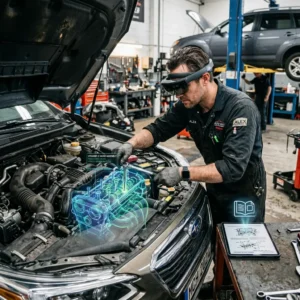
Automakers like Porsche have solved this using a remote AR support system known as “Tech Live Look.” If a local dealership mechanic runs into an unfamiliar, highly complex repair, they simply put on a pair of AR smart glasses. A technician sitting hundreds of miles away at Porsche headquarters can immediately tap into the glasses and see a live feed of exactly what the local mechanic is looking at.
But it goes beyond video calling. The experienced technician can digitally draw arrows that “stick” to the physical engine block in the local mechanic’s view, highlighting the exact bolt to remove. They can project specific service manuals or torque specifications directly into the mechanic’s field of vision. This real-time, spatial collaboration eliminates the need for expensive travel, reducing repair resolution times and ensures high-quality service regardless of location limitations.
Holographic Workspaces
The design and prototyping phases of product development are historically slow and material-intensive. Automotive manufacturers traditionally spend months sculpting life-size clay models to finalise car designs, costing vast amounts of money and requiring all key stakeholders to be in the same physical room for reviews.
Today, companies like Ford are utilising headsets to create virtual collaborative workspaces. Instead of building physical prototypes, designers located in different countries can put on their headsets and view the exact same life-size, 3D holographic vehicle sitting in the middle of their offices.
They can physically walk around the virtual car, lean in to inspect the interior dashboard, and make changes to the grille design in real-time. A designer in the UK can leave a digital note hovering in the air next to the bumper for an engineer in the US to review the next morning. This accelerates the design cycle, completely bypasses heavy material costs and allows global teams to collaborate natively in 3D without getting on a plane.
The True Business ROI of Spatial Computing
When you look past the futuristic aesthetics of AR headsets, the business case for spatial computing in 2026 is incredibly grounded. It revolves around four core pillars of ROI:
- Error Reduction: By overlaying instructions exactly where the work is happening, you remove the guesswork and cognitive load that lead to mistakes.
- Increased Productivity: Keeping workers’ hands free and guiding them spatially speeds up physical workflows by double-digit percentages.
- Accelerated Training: New employees can be guided through complex tasks by digital overlays, drastically reducing onboarding times and the need for intense, classroom-style training.
- Cost Mitigation: Whether it is reducing the need to build physical prototypes or eliminating the travel costs of flying out expert technicians, AR bridges physical distances instantaneously.
Ready to Build the Future of Your Operations?
At Red C, we don’t just build enterprise apps for screens; we build intelligent, spatial solutions for the real world. As an award-winning development agency in London, we understand that adopting AR isn’t just about deploying cool technology; it is about solving complex bottlenecks and delivering a measurable return on investment.
Whether you are looking to develop a hands-free warehouse picking application, an interactive 3D training module for your manufacturing floor or a complex data-visualisation tool for remote engineers, our team has the technical expertise to bring your vision to life. We specialise in custom integrations, ensuring that your new spatial computing tools communicate seamlessly with your existing enterprise systems and databases.
Learn more about our Augmented Reality Development services or contact the Red C team today to discuss your next big project.